Terrestrial Genomics and Adaptive Biodesign
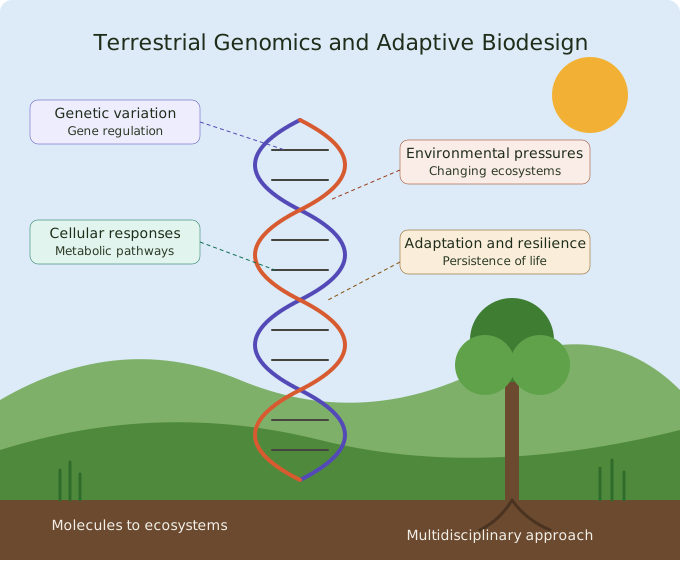
Exploring the Molecular Foundations of Terrestrial Life
Terrestrial Genomics and Adaptive Biodesign explores the intricate relationships between genetic information, biological organization, environmental conditions, and adaptive processes across terrestrial systems. By bringing together genomics, molecular biology, evolutionary science, ecological research, and computational analysis, this scientific perspective examines how living organisms develop, respond to environmental pressures, and maintain biological functions within changing ecosystems.
Understanding terrestrial life requires an integrated perspective on molecular mechanisms and broader biological interactions. Genetic variation, gene regulation, cellular responses, metabolic pathways, and environmental influences collectively contribute to the diversity and resilience of living organisms. Investigating these connections creates opportunities to better understand biological adaptation and the mechanisms underlying the development, organization, and persistence of terrestrial ecosystems.
Through a multidisciplinary approach, this research-oriented platform explores biological complexity, connecting molecular discoveries with ecological observations and emerging scientific methodologies.
Genomic Research and Molecular Diversity
Genomic research provides essential insights into the organization, function, and variation of genetic material. By examining DNA sequences, gene structures, regulatory elements, and molecular interactions, researchers can investigate the biological characteristics that distinguish organisms and influence their responses to environmental conditions.
Comparative genomics supports the identification of similarities and differences among species, helping researchers investigate evolutionary relationships and patterns of biological diversification. Advances in sequencing technologies and computational biology have expanded the possibilities for studying complex genomes, identifying functional regions, and interpreting large-scale molecular datasets.
Major areas of genomic investigation include genome organization, sequence variation, genetic diversity, gene expression, transcriptional regulation, and the molecular mechanisms associated with environmental responses. Functional genomics further contributes to the characterization of genes and biological pathways, supporting investigations into the relationships between genetic information and observable biological characteristics.
The integration of these research areas contributes to a more comprehensive understanding of the molecular foundations of terrestrial organisms.

Adaptive Biology and Environmental Interactions
Living organisms continuously interact with their surroundings. Changes in temperature, water availability, nutrient distribution, light exposure, and other environmental conditions can influence physiological processes, cellular activity, and patterns of gene expression.
Adaptive biology investigates the mechanisms through which organisms respond to environmental challenges over different timescales. These responses may involve modifications in gene regulation, metabolic activity, cellular signaling, developmental processes, and physiological performance.
Understanding adaptation requires examining both the genetic characteristics of organisms and the environmental contexts in which biological traits emerge. Research combining molecular observations with ecological data can help clarify how biological systems respond to changing conditions and how variation contributes to differences in organism performance.
The relationship between inherited genetic variation and environmental influences remains an important subject in evolutionary biology. By investigating these interconnected processes, researchers can develop more detailed explanations of biological diversity, environmental responses, and organism resilience.
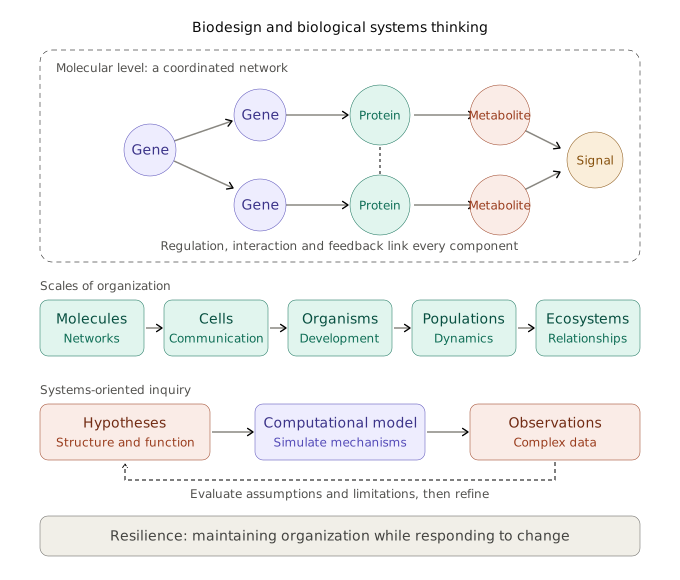
Biodesign and Biological Systems Thinking
Biodesign provides a conceptual framework for examining biological systems through principles of organization, functionality, interaction, and adaptation. Drawing on systems biology, molecular engineering, computational modeling, and ecological thinking, this perspective encourages researchers to investigate how biological components function together rather than treating individual processes as isolated events.
At the molecular level, biological systems depend on coordinated networks of genes, proteins, metabolites, and regulatory signals. At larger scales, these interactions contribute to cellular behavior, organism development, population dynamics, and ecological relationships.
A systems-oriented approach can help researchers formulate hypotheses, interpret complex observations, and identify relationships between biological structure and function. Computational simulations and mathematical models can further support the exploration of biological mechanisms, provided that their assumptions and limitations are carefully evaluated.
Important themes include biological networks, molecular organization, gene regulatory systems, cellular communication, computational modeling, and the principles underlying biological resilience. Together, these perspectives support a deeper exploration of how complex biological systems maintain organization while responding to internal and external changes.