Terrestrial Biodiversity and Evolutionary Processes
Exploring Genetic Diversity, Evolutionary Change, and Ecological Relationships
Terrestrial biodiversity reflects the remarkable diversity of living organisms and the evolutionary processes that have shaped their characteristics, distributions, and ecological relationships over time. From microscopic soil microorganisms to complex plant communities and terrestrial animals, biological diversity emerges through interactions between genetic variation, environmental conditions, ecological dynamics, and evolutionary history.
Understanding this diversity requires an integrated perspective that connects molecular biology, population genetics, evolutionary theory, ecology, and genomics. These disciplines provide complementary methods for investigating how organisms differ, how populations change across generations, and how environmental conditions influence the distribution of biological characteristics.
Evolutionary processes contribute to the formation of new adaptations, the differentiation of populations, and the diversification of species. At the same time, ecological interactions influence survival, reproduction, resource availability, and the persistence of biological communities.
By examining these interconnected mechanisms, researchers can develop a deeper understanding of the origins, organization, and continuing transformation of terrestrial biodiversity.
Genetic Variation as the Foundation of Biodiversity
Genetic variation represents one of the fundamental components of biological diversity. Differences in DNA sequences among individuals can influence molecular functions, physiological characteristics, developmental patterns, and responses to environmental conditions.
Variation may arise through mutations, genetic recombination, chromosome rearrangements, and other molecular processes. Once introduced into a population, genetic differences may become more or less common depending on reproductive patterns, environmental pressures, migration, and random changes in allele frequencies.
The distribution of genetic variation within and between populations provides valuable information about evolutionary history. Populations with substantial genetic diversity may contain a broader range of heritable characteristics, although the consequences of this variation depend on environmental context and the biological traits involved.
Molecular techniques allow researchers to examine genetic differences at multiple levels, from individual nucleotide substitutions to larger genomic changes. These investigations support the identification of population structure, the comparison of related organisms, and the study of evolutionary relationships.
Understanding genetic variation is therefore essential for investigating how biodiversity develops and how populations respond to changing environmental conditions.

Evolutionary Mechanisms and Biological Change
Evolution describes changes in heritable characteristics across generations. Several mechanisms contribute to evolutionary change, each influencing genetic variation and population composition in different ways.
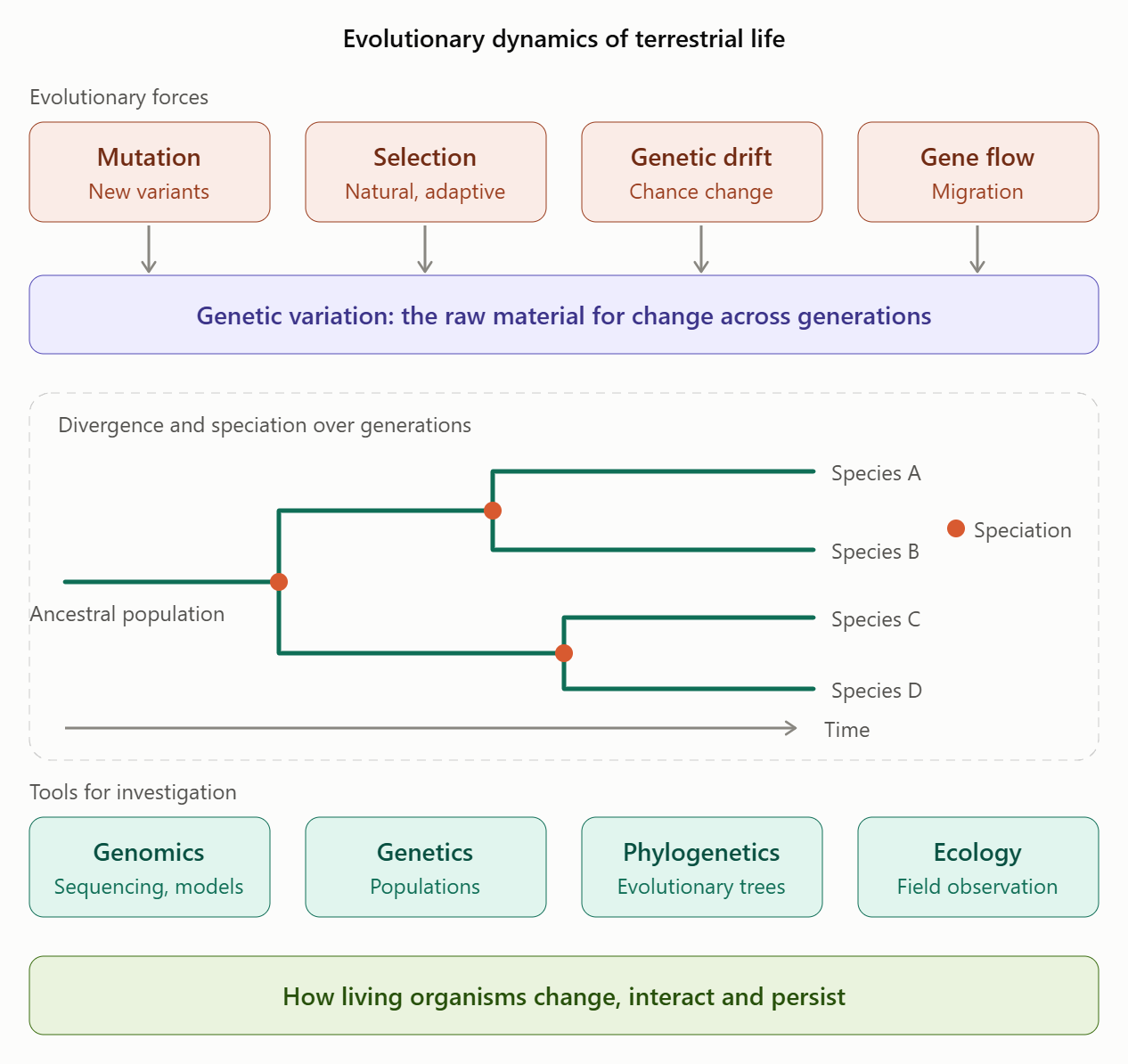
Natural selection occurs when heritable differences influence reproductive success under particular environmental conditions. Genetic drift refers to random changes in allele frequencies, which can have especially strong effects in small populations. Gene flow introduces genetic material between populations, while mutation generates new genetic variation.
Recombination produces new combinations of existing genetic variants, contributing to the diversity of genotypes within populations. These mechanisms interact rather than operating independently, creating complex evolutionary patterns.
The relative importance of each process varies according to population size, reproductive biology, geographical distribution, environmental conditions, and the characteristics of the organisms being studied.
Investigating these mechanisms helps researchers explain why populations diverge, how biological traits change over time, and why closely related organisms may exhibit different characteristics under different conditions.
Population Genetics and Evolutionary Structure
Population genetics examines the distribution and transmission of genetic variation within populations. By studying allele frequencies, genetic diversity, inbreeding, migration, and reproductive patterns, researchers can investigate the mechanisms responsible for population differentiation.
Populations may become genetically distinct when geographical barriers, ecological differences, or reproductive restrictions reduce the exchange of genetic material. Conversely, migration and interbreeding can maintain genetic connections between populations that occupy different regions.
Population structure can be investigated using molecular markers, genome-wide variation, and statistical approaches that identify patterns of genetic similarity. These methods can reveal historical separations, recent migration events, and differences in reproductive connectivity.
The interpretation of population structure requires careful consideration of sampling design, demographic history, and the biological characteristics of the species under investigation.
By combining population genetics with ecological and geographical information, researchers can develop more comprehensive explanations of how populations are distributed and how evolutionary processes shape their genetic composition.

Speciation and the Formation of Biological Diversity
Speciation is the evolutionary process through which populations develop reproductive isolation and become distinct species. It often involves the accumulation of genetic differences, changes in ecological relationships, and the development of barriers to reproduction.
Geographical separation can reduce gene flow between populations, allowing independent evolutionary changes to accumulate. In other circumstances, populations may diverge while occupying the same geographical region because of ecological specialization, sexual selection, or differences in reproductive behavior.
Reproductive isolation may develop through prezygotic mechanisms, which reduce the likelihood of mating or fertilization, or postzygotic mechanisms, which affect the viability or reproductive success of hybrid offspring.
Genomic comparisons, phylogenetic analyses, ecological observations, and reproductive studies provide complementary evidence for investigating the formation of species.
Speciation research helps explain the origins of biological diversity and the processes through which evolutionary lineages become differentiated over time.
Phylogenetics and Evolutionary Relationships
Phylogenetics investigates the evolutionary relationships among organisms by reconstructing their shared ancestry. Researchers use morphological characteristics, molecular sequences, genomic information, and other forms of evidence to develop hypotheses about how lineages are related.
DNA and protein sequences are particularly useful for comparing organisms because inherited molecular similarities can provide information about evolutionary history. However, sequence comparisons must account for mutation rates, differences among genes, evolutionary models, and possible conflicts between gene histories and species histories.
Phylogenetic trees represent hypotheses about evolutionary relationships. Their structure can help identify shared ancestors, distinguish related lineages, and investigate patterns of diversification.
Molecular phylogenetics also supports comparative studies of biological characteristics, allowing researchers to examine whether particular traits evolved once or independently in different lineages.
When combined with ecological and geographical evidence, phylogenetic analysis provides a framework for exploring the historical processes that have shaped terrestrial biodiversity.

Environmental Adaptation and Natural Selection
Environmental conditions influence the survival and reproduction of organisms, creating opportunities for natural selection to change the frequency of heritable traits across generations.
Temperature, water availability, soil composition, light exposure, nutrient distribution, and interactions with other organisms can influence biological performance. Populations may therefore exhibit differences in traits associated with their local environments.
Adaptation involves heritable characteristics that become more common through natural selection because they contribute to reproductive success in a particular context. It should be distinguished from short-term physiological acclimation, which involves changes within an individual and does not necessarily produce inherited evolutionary change.
Researchers investigate adaptation through field observations, common-garden experiments, reciprocal-transplant studies, population genomics, and measurements of biological performance.
These methods can help distinguish genetic contributions from environmental influences and identify candidate mechanisms underlying differences between populations.
Understanding adaptation provides important insights into evolutionary responses to environmental variability and the ecological conditions that influence biological diversity.
Plant Diversity and Terrestrial Evolution
Plants represent a major component of terrestrial biodiversity, contributing to ecosystem structure, primary production, nutrient cycling, and the availability of habitats for other organisms.
Plant evolution has involved the development of diverse reproductive strategies, structural characteristics, physiological mechanisms, and environmental responses. Differences in genome organization, gene regulation, and inherited traits contribute to the diversity observed across plant lineages.
Comparative plant genomics helps researchers investigate evolutionary relationships, identify conserved genetic mechanisms, and characterize molecular differences associated with plant development and environmental responses.
The study of plant diversity also includes interactions between genetic characteristics and ecological conditions. Differences in soil composition, water availability, temperature, and competition can influence plant distribution and reproductive success.
By integrating molecular, physiological, and ecological evidence, researchers can investigate the evolutionary history of plant groups and the mechanisms contributing to their diversification across terrestrial environments.

Soil Microorganisms and Hidden Biodiversity
A substantial component of terrestrial biodiversity exists below ground, where bacteria, archaea, fungi, and other microorganisms contribute to ecological processes that sustain terrestrial ecosystems.
Soil microbial communities participate in organic matter decomposition, nutrient transformation, mineral interactions, and relationships with plant roots. Their composition and activity are influenced by soil structure, moisture, pH, temperature, vegetation, and resource availability.
Microbial diversity can be examined using DNA sequencing, metagenomics, functional gene analysis, and complementary ecological measurements. These approaches help characterize microbial communities and investigate the genetic potential associated with particular environmental conditions.
Microbial evolution is influenced by mutation, selection, genetic exchange, population dynamics, and interactions among microorganisms and their hosts. These processes can generate substantial diversity across different habitats.
Understanding soil biodiversity is essential for explaining the complexity of terrestrial ecosystems and the biological interactions that influence nutrient availability and ecosystem functioning.
Ecological Interactions and Community Organization
Terrestrial biodiversity is shaped not only by evolutionary history but also by interactions among organisms. Competition, predation, herbivory, parasitism, mutualism, and facilitation influence the distribution and abundance of species within ecological communities.
Competition can affect access to limited resources, while predation and herbivory influence population dynamics and patterns of resource use. Mutualistic relationships, including interactions between plants and pollinators or between roots and beneficial microorganisms, can contribute to the functioning of ecological systems.
These interactions may change according to environmental conditions, species composition, and the availability of resources. A relationship that benefits an organism under one set of conditions may have different consequences under another.
Ecological network analysis provides methods for investigating these relationships and identifying patterns of connectivity among species. When combined with genetic and evolutionary information, network approaches can help researchers examine how biological interactions develop and change over time.
Studying ecological relationships provides a broader perspective on the mechanisms that maintain biodiversity and influence community organization.
Genomic Technologies for Biodiversity Research
Advances in molecular biology and sequencing technologies have expanded the methods available for investigating terrestrial biodiversity. Researchers can now examine genetic variation across large numbers of organisms and compare molecular information across populations, species, and ecological communities.
Environmental DNA analysis allows researchers to investigate biological material collected from soil, water, or other environmental samples. Depending on sampling design and analytical methods, these approaches can help detect organisms that may be difficult to observe directly.
Metabarcoding uses selected genetic regions to characterize multiple taxa within a sample, while metagenomic approaches can provide broader information about the genetic material present in complex microbial communities.
Whole-genome sequencing and population genomics support more detailed investigations of genetic variation, demographic history, and evolutionary relationships. Computational tools are essential for processing these datasets, evaluating sequence quality, and interpreting molecular patterns.
Although genomic technologies provide powerful research opportunities, their results must be interpreted in light of sampling limitations, reference database coverage, detection biases, and the distinction between the presence of genetic material and the presence of living organisms.
Climate Change and Evolutionary Responses
Environmental change can alter the conditions under which organisms survive, reproduce, and interact. Changes in temperature, precipitation, seasonal patterns, and habitat availability may influence species distributions and population dynamics.
Some populations may respond through migration, phenotypic plasticity, or evolutionary changes across generations. Other populations may experience reduced reproductive success or decline when environmental changes exceed their capacity to respond.
Evolutionary responses depend on factors such as standing genetic variation, generation time, population size, migration, and the strength and direction of selection. Ecological interactions can further influence the outcomes of environmental change.
Researchers combine long-term ecological observations, climate information, population genetics, and experimental approaches to investigate these responses. Such studies can help distinguish short-term fluctuations from longer-term changes in population composition and distribution.
Examining climate-related evolutionary processes contributes to a more detailed understanding of how terrestrial biodiversity may change under different environmental scenarios.
Biodiversity Assessment and Conservation Genetics
Biodiversity assessment involves characterizing biological variation at genetic, species, and ecosystem levels. Different measures provide complementary information about the composition, distribution, and organization of biological communities.
Species richness describes the number of species in a defined area, while diversity indices can incorporate both species richness and relative abundance. Genetic diversity provides additional information about variation within populations and the evolutionary potential associated with that variation.
Conservation genetics applies population-genetic principles to questions involving threatened populations, habitat fragmentation, inbreeding, genetic connectivity, and demographic change.
Molecular data can help identify distinct populations, estimate patterns of gene flow, and evaluate genetic differences among geographically separated groups. These findings can inform scientific assessments of population structure and support the development of evidence-based conservation strategies.
Reliable biodiversity assessment requires appropriate sampling, transparent analytical procedures, and consideration of uncertainty. Genetic evidence is most informative when interpreted alongside ecological observations, population trends, and the characteristics of the species concerned.
Integrating Molecular, Evolutionary, and Ecological Evidence
A comprehensive understanding of terrestrial biodiversity requires information from multiple levels of biological organization. Molecular studies reveal genetic mechanisms, population analyses characterize patterns of variation, evolutionary research investigates historical change, and ecological observations describe the relationships between organisms and their environments.
Integrating these perspectives can help researchers investigate questions that cannot be fully addressed using a single method. For example, genomic differences among populations can be examined alongside environmental measurements to explore potential relationships between genetic variation and habitat conditions.
Computational approaches support the organization and analysis of complex datasets, including genomic sequences, phylogenetic information, geographical records, and ecological measurements.
However, associations between genetic variation and environmental variables do not automatically demonstrate causation. Robust interpretation requires suitable experimental or comparative designs, statistical evaluation, and consideration of alternative explanations.
Interdisciplinary research therefore benefits from combining complementary evidence while maintaining clear distinctions between observed patterns, supported conclusions, and hypotheses requiring further investigation.
Future Directions in Biodiversity and Evolutionary Research
Emerging technologies continue to expand the possibilities for studying biological diversity. Long-read sequencing, improved environmental DNA methods, spatial molecular analysis, and advanced computational models offer new ways to investigate organisms and ecological communities.
Artificial intelligence and machine learning may support species classification, genomic pattern recognition, ecological prediction, and the analysis of large biodiversity datasets. Their reliability depends on the quality and representativeness of training data, appropriate validation, and careful interpretation of model outputs.
Future research will also benefit from improved integration of genomic information with geographical, environmental, and long-term ecological observations. Such integration can help clarify how evolutionary history, current environmental conditions, and biological interactions collectively shape terrestrial biodiversity.
Continued progress depends on reproducible analytical workflows, well-documented datasets, interdisciplinary collaboration, and responsible communication of scientific uncertainty.
Conclusion: Understanding the Evolutionary Dynamics of Terrestrial Life
Terrestrial biodiversity represents the outcome of interconnected molecular, evolutionary, ecological, and environmental processes. Genetic variation provides the material for evolutionary change, while natural selection, genetic drift, mutation, and gene flow influence the characteristics of populations across generations.
Speciation, ecological interactions, environmental adaptation, and historical changes in geographical distribution contribute to the diversity of organisms and the structure of terrestrial communities.
Modern genomic technologies and computational methods provide increasingly detailed tools for investigating these processes. When combined with population genetics, phylogenetics, ecological observations, and rigorous experimental design, they support a more comprehensive understanding of the origins and dynamics of biological diversity.
The study of terrestrial biodiversity and evolutionary processes therefore remains central to understanding how living organisms change, interact, and persist within a continually evolving natural world.