
Exploring New Methods for Understanding Biological Complexity
1. Advanced Sequencing Technologies and Genome Analysis
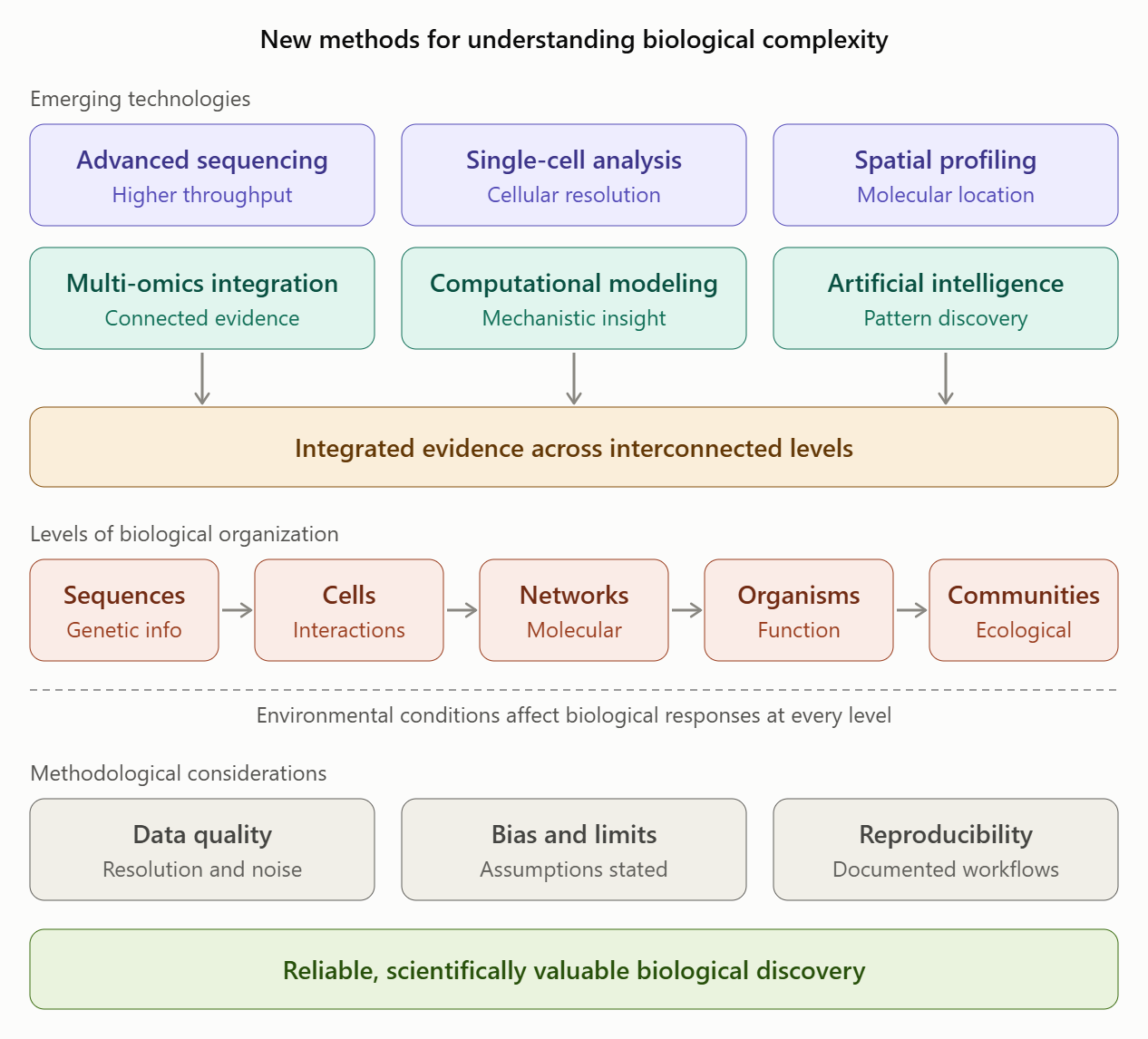
DNA sequencing remains a fundamental technology in modern genomics. It enables researchers to determine the order of nucleotide bases in genetic material and investigate the molecular differences that contribute to biological diversity.
Next-generation sequencing technologies have made it possible to analyze large numbers of DNA fragments in parallel. These methods support genome sequencing, transcriptomic profiling, genetic variant identification, and the characterization of microbial communities.
Long-read sequencing technologies provide complementary capabilities by generating substantially longer DNA or RNA sequence reads. Longer reads can help resolve repetitive genomic regions, characterize structural variants, investigate complex genomic arrangements, and improve the assembly of genomes that are difficult to reconstruct using shorter fragments.
The choice of sequencing technology depends on the research question, sample characteristics, required resolution, available resources, and analytical objectives. Short-read sequencing may provide efficient coverage for many applications, whereas long-read methods can offer advantages when investigating complex structural features.
Despite continued progress, sequencing results require careful quality assessment, appropriate reference resources, and suitable computational workflows. Errors introduced during sample preparation, sequencing, or data processing can influence downstream interpretation.
The integration of complementary sequencing methods is therefore becoming increasingly important for producing reliable genomic information and developing a more complete understanding of genetic organization.

2. Single-Cell Technologies and Cellular Heterogeneity
Biological tissues are composed of cells that may differ in their molecular characteristics, developmental states, and functional activities. Traditional bulk analysis measures signals from many cells simultaneously, potentially obscuring differences between individual cell populations.
Single-cell technologies address this limitation by enabling researchers to investigate molecular features at the level of individual cells. Single-cell RNA sequencing, for example, can characterize gene expression patterns across thousands of cells and reveal populations with distinct transcriptional profiles.
These approaches are valuable for studying cellular differentiation, tissue organization, immune-cell diversity, developmental processes, and changes associated with experimental conditions.
Single-cell analysis can also help identify rare cell populations that might contribute only a small proportion of the total signal in bulk measurements. By examining these populations separately, researchers can investigate biological heterogeneity with greater resolution.
However, single-cell experiments introduce technical challenges. Differences in RNA capture efficiency, sequencing depth, cell viability, sample preparation, and computational normalization can influence observed patterns.
Careful experimental design and appropriate statistical methods are essential for distinguishing genuine biological differences from technical variation. When these considerations are addressed, single-cell technologies can provide valuable insights into the complexity of cellular systems.

3. Spatial Molecular Profiling and Tissue Organization
Although single-cell methods provide detailed molecular information, conventional single-cell sequencing generally separates cells from their original tissue context. This can make it difficult to determine where particular molecular signals originated.
Spatial molecular profiling seeks to address this challenge by preserving or reconstructing the locations of biological signals within tissues. Spatial transcriptomics, multiplexed imaging, and related approaches allow researchers to investigate gene expression and other molecular characteristics in relation to tissue architecture.
These technologies can help characterize differences between neighboring cell populations, examine localized signaling environments, and investigate how cellular organization contributes to biological function.
For example, a tissue may contain regions with different metabolic activities, patterns of gene expression, or interactions between resident cell populations. Spatial analysis can reveal these patterns while maintaining information about their location.
The combination of spatial profiling and single-cell analysis can provide complementary perspectives: one describes molecular characteristics at cellular resolution, while the other helps place these characteristics within their biological surroundings.
Challenges include high experimental costs for certain platforms, differences in spatial resolution, tissue preservation requirements, and the computational complexity of integrating molecular and imaging data.
As analytical methods continue to develop, spatial technologies are expanding the possibilities for investigating how the organization of cells contributes to the behavior of complex biological systems.
4. Multi-Omics Integration and Systems Biology
Biological processes rarely depend on a single molecular component. Genomes, transcripts, proteins, metabolites, and regulatory signals interact to produce the functional characteristics observed in cells and organisms.
Multi-omics research combines information from different molecular measurement layers to investigate these interactions. Genomics examines genetic information, transcriptomics measures RNA abundance, proteomics characterizes proteins, and metabolomics investigates small molecules associated with cellular and metabolic activity.
Integrating these datasets can help researchers investigate relationships between genetic variation, gene expression, protein abundance, and metabolic changes.
For example, a change in gene expression does not necessarily produce a proportional change in protein abundance. Protein stability, translation efficiency, post-translational modifications, and degradation mechanisms can influence the relationship between RNA and protein measurements.
Multi-omics analysis provides opportunities to examine these differences and develop more detailed models of biological regulation.
However, combining multiple datasets is not straightforward. Different technologies generate measurements with distinct statistical properties, dynamic ranges, missing-data patterns, and experimental limitations.
Reliable integration requires appropriate normalization, carefully matched samples, suitable statistical frameworks, and independent validation where possible.
When applied rigorously, multi-omics approaches can help bridge the gap between molecular measurements and the complex mechanisms underlying biological function.

5. Artificial Intelligence in Genomic Research
Artificial intelligence is increasingly being explored as a tool for analyzing complex biological datasets. Machine learning methods can identify patterns in large collections of sequences, molecular measurements, images, and experimental observations.
In genomics, computational models may support sequence classification, functional annotation, variant prioritization, and the prediction of relationships between genetic features and biological characteristics.
Deep learning methods can process complex data representations and identify patterns that may be difficult to capture using simpler analytical approaches. These methods are being investigated for applications involving protein structure, regulatory sequences, gene expression, and molecular interactions.
Artificial intelligence can also support image analysis by identifying cellular structures, classifying tissue regions, and quantifying experimental signals. In some workflows, automated analysis can reduce repetitive manual tasks and improve consistency when models are appropriately validated.
Nevertheless, computational predictions should not be treated as direct experimental evidence. A model may perform well on one dataset but produce unreliable results when applied to different organisms, laboratories, experimental conditions, or populations.
Bias in training data, insufficient sample diversity, model overfitting, and limited interpretability can all affect performance.
Effective use of artificial intelligence therefore requires transparent methods, suitable validation datasets, appropriate statistical comparisons, and biological interpretation by qualified researchers.
6. CRISPR-Based Technologies and Functional Genomics
Functional genomics investigates how genes and regulatory elements contribute to biological processes. Genome-editing technologies have expanded the experimental approaches available for testing these relationships.
CRISPR-based systems use programmable molecular components to target selected genetic sequences. Depending on the system, they can support DNA modification, transcriptional regulation, or other forms of targeted molecular investigation.
CRISPR-associated approaches have enabled researchers to examine gene function, investigate regulatory networks, and develop experimental models for studying biological mechanisms.
Genome-wide screening strategies can assess the effects of modifying many genetic targets across experimental systems. These studies may help identify genes associated with particular cellular characteristics or responses to defined experimental conditions.
The interpretation of genome-editing experiments requires attention to editing efficiency, unintended changes, cellular context, and potential compensatory mechanisms. A phenotype observed after modifying a gene does not always reveal the complete mechanism through which that gene influences the biological system.
Independent validation and complementary experiments are important for establishing reliable conclusions.
As functional genomics advances, targeted molecular technologies continue to provide tools for connecting genetic information with biological activity.

7. Metagenomics and Environmental DNA Analysis
Many organisms cannot be comprehensively studied using conventional observation or cultivation methods alone. Molecular analysis of environmental samples provides alternative ways to investigate biological diversity.
Metagenomics examines genetic material recovered from complex microbial communities. Depending on the experimental design, it can provide information about community composition, gene content, and potential biological functions.
Environmental DNA analysis investigates genetic material present in environmental samples such as soil, freshwater, or other collected materials. These methods can help detect evidence of organisms that may be difficult to observe directly.
DNA metabarcoding uses selected genetic regions to characterize multiple taxa within a sample, making it useful for biodiversity surveys and ecological monitoring when suitable reference sequences and validated methods are available.
These technologies have applications in microbial ecology, terrestrial biodiversity research, ecosystem studies, and the investigation of relationships between organisms and environmental conditions.
However, detecting genetic material does not automatically establish that an organism is alive, active, or present at a particular abundance. DNA persistence, sample contamination, primer selection, and incomplete reference databases can affect the interpretation of results.
Careful sampling strategies and appropriate controls are therefore essential for producing reliable environmental molecular data.
8. Organ-on-Chip Systems and Advanced Biological Models
The development of biological models is another important area of technological innovation. Conventional cell cultures provide controlled experimental environments, but they may not reproduce all the structural and physiological features of complex tissues.
Organ-on-chip systems use engineered microenvironments to support selected cellular interactions under controlled conditions. These platforms can incorporate fluid flow, mechanical forces, and combinations of cell types to investigate particular aspects of tissue function.
Researchers use these systems to study cellular responses, tissue-level interactions, barrier properties, and selected physiological processes. Depending on their design, they can provide experimental conditions that complement conventional cell cultures and animal models.
Advanced three-dimensional cell cultures and organoids offer additional opportunities to investigate cellular organization and developmental processes. Their characteristics depend on the cell source, culture conditions, and specific biological system being modeled.
These approaches have important limitations. A model may reproduce selected features of a tissue without capturing the complete complexity of an intact organism. Differences in maturation, immune components, vascularization, and long-term stability can affect experimental interpretation.
For this reason, model selection should be guided by the biological question and supported by appropriate validation. Combining different experimental systems may provide stronger evidence than relying on a single model.
9. Automation, Robotics, and High-Throughput Biology
Automation is transforming laboratory workflows by improving the consistency and throughput of selected experimental procedures. Robotic liquid handling, automated sample preparation, imaging systems, and integrated analytical platforms can support the processing of large numbers of samples.
High-throughput approaches are particularly useful when researchers need to compare multiple experimental conditions, investigate numerous molecular targets, or perform systematic screening studies.
Automation can reduce repetitive manual work and help standardize procedures. However, it does not automatically eliminate experimental error. Instrument calibration, sample tracking, reagent quality, software configuration, and workflow validation remain essential.
Laboratory information management systems and structured digital records can help organize samples, document experimental conditions, and improve traceability.
The combination of automation and computational analysis also enables more integrated research workflows in which experimental measurements are processed and evaluated using predefined analytical procedures.
Successful implementation requires careful planning, quality control, and attention to the reproducibility of both physical laboratory procedures and digital data processing.

10. Cloud Computing and Biological Data Infrastructure
Modern biological research generates datasets that can exceed the storage and processing capabilities of individual laboratory computers. Cloud computing and distributed computational infrastructure provide additional resources for managing these data-intensive workflows.
Cloud-based environments can support sequence alignment, genome assembly, variant analysis, transcriptomic processing, and collaborative data analysis. They may also facilitate the use of specialized software and scalable computational resources.
Reproducible computational environments can help researchers document software dependencies, analysis parameters, and processing steps. Workflow management systems can further improve consistency when complex analyses involve multiple interconnected stages.
Data infrastructure is particularly important for collaborative research involving large genomic datasets collected across different laboratories or geographical locations.
Nevertheless, cloud-based analysis requires attention to data security, access permissions, computational costs, privacy requirements, and the responsible management of sensitive biological information.
A well-designed computational infrastructure can support more efficient research, but its scientific value ultimately depends on data quality, analytical rigor, and transparent documentation.
11. Digital Twins and Predictive Biological Modeling
Digital twins are computational representations of selected aspects of physical systems that can be updated or evaluated using relevant data. In biological research, related modeling approaches are being explored to represent cellular processes, physiological systems, and interactions between biological components.
A biological model may combine experimental measurements, mathematical equations, and computational simulations to investigate how a system behaves under different conditions.
Such approaches can help researchers compare hypotheses, explore potential mechanisms, and identify variables that may influence experimental outcomes.
However, biological systems are highly complex and can display nonlinear behavior, variability, and context-dependent responses. A computational representation therefore captures only selected features of the system it describes.
The reliability of predictions depends on the assumptions, quality of input data, model structure, and validation procedures.
Although digital-twin approaches remain at different stages of development across biological applications, they illustrate the growing interest in connecting experimental data with dynamic computational representations.
12. Data Quality, Reproducibility, and Research Integrity
Technological advances increase the amount of biological information available, but more data do not automatically produce more reliable scientific conclusions.
Data quality depends on appropriate sample collection, validated measurement procedures, suitable experimental controls, and consistent documentation. Computational analysis introduces additional considerations, including normalization, statistical assumptions, missing values, and the selection of reference datasets.
Reproducibility requires sufficient information about experimental methods and analytical workflows for other researchers to understand how results were generated. Transparent reporting of limitations is equally important when interpreting complex biological measurements.
Researchers should distinguish between exploratory findings, statistical associations, mechanistic explanations, and experimentally validated conclusions. These categories represent different levels of evidence and should not be treated as interchangeable.
Independent validation, suitable reference materials, robust statistical analysis, and the careful evaluation of alternative explanations strengthen the scientific value of emerging technologies.
Maintaining research integrity is essential for ensuring that technological innovation contributes to dependable biological knowledge.
13. Integrating Emerging Technologies into Future Research
Conclusion: Technology as a Foundation for Biological Discovery
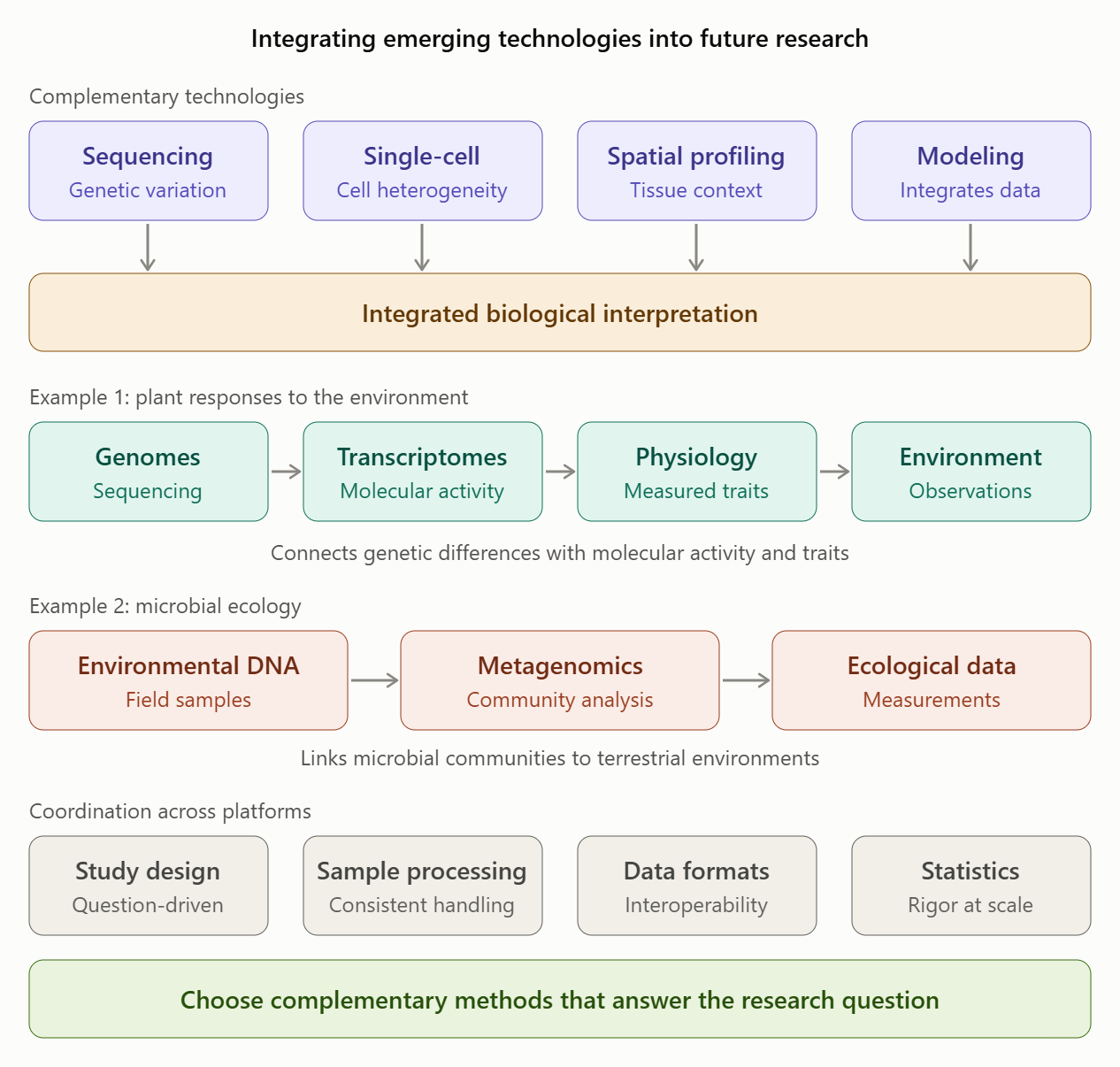
Emerging technologies are expanding the possibilities for investigating genomes, cellular systems, molecular interactions, and ecological relationships. Advances in sequencing, single-cell analysis, spatial profiling, multi-omics, genome editing, and computational biology provide researchers with increasingly detailed ways to examine living systems.
Artificial intelligence, laboratory automation, cloud computing, and advanced biological models are also changing how experiments are designed, conducted, and interpreted.
Despite these developments, technological sophistication alone does not guarantee scientific progress. Reliable discoveries depend on carefully formulated questions, suitable experimental designs, high-quality data, appropriate analytical methods, and transparent interpretation.
The integration of molecular, computational, and ecological perspectives offers opportunities to investigate biological complexity across multiple levels of organization. As these approaches continue to evolve, emerging technologies will remain important tools for understanding genetic variation, cellular function, evolutionary processes, and the dynamic relationships that shape life.